

Why aren't my Facebook ads working?
Facebook and Meta ads that used to work and now don't are usually suffering from four things. Outdated campaign structure (too many small audiences instead of one consolidated Advantage+ campaign). Stale creative that isn't refreshed often enough, no lead generation campaign feeding email and no one monitoring account health as Meta's algorithm has changed.
A healthy ecommerce ROAS benchmark in Australia is 3-4x. This case study shows one swimwear brand's ROAS drop from 3.56 to 1.56, why it happened, and the Meta Ads Setup process used to fix it, without handing the account over to an agency.
Below is a real example of what that actually looks like in an account, and what fixing it involves.
If you've typed some version of ‘Why have my Meta Ads stopped working’ into Google at 11 pm, you're not alone.
It's one of the most common things I hear on discovery calls, usually from someone who used to have ads that worked, and now they just... don't.
That's exactly where one of my recent clients was.
"It's all got really messy"
She's the founder of a swimwear brand, the kind of business I love working with; independent, values-driven, built from scratch.
She'd done an ecommerce ads course a couple of years back, and it worked. Ads were performing well, she felt confident, so she kept running them herself.
Then the last six months happened.
Here's how she put it on our first call:
"I feel like it's got all really messy in my ads now, because I started doing random stuff, experimenting. Now it's all looking a bit chaotic, and I'm not sure what is working."
That's not a lack of knowledge or effort; it’s what happens when Meta changes faster than anyone tells you it has, and you're left troubleshooting alone.
Why did her ROAS drop?
We pulled up her Ads Manager together, live on the call. This is where it got real.
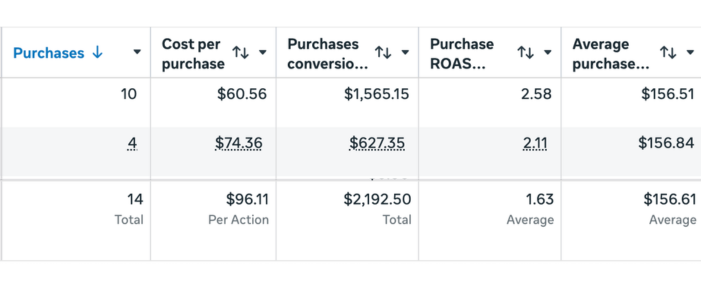
The Average ROAS for the last 14 days: 1.63.
For the last 30 days: 1.56.
She'd had it sitting around 2.40 not that long before.
For ecommerce, you're generally wanting a ROAS of 3 to 4 to be in a healthy, profitable campaign.
A ROAS of 1.56 means she was basically making her ad spend back and not much else.
Not a disaster, but nowhere near where it needed to be, especially when she was spending around $120 a day.
Is it your ads, or your account structure?
When we dug into her account, a clear pattern showed up, one I see constantly with brands who've been running their own ads for a while.
She was still running the old-style funnel: top of funnel, middle of funnel, bottom of funnel, each with detailed targeting layered into every ad set, and minimal ad creative feeding it.
That structure used to be best practice. It's not anymore.
Why her account structure was working against her
The old way of setting up Meta ads meant multiple campaigns, each with its own budget, narrowly targeting a specific audience, usually with a single ad running in its own ad set.
You picked the audience, placements and managed it all manually, and Meta mostly did what it was told.
That's not how the platform works anymore.
Meta's rebuilt the system behind the scenes with two AI models:
Andromeda and GEM
Andromeda is Meta's ad-matching engine. Instead of relying mainly on the audience you've targeted, it looks at the ad itself — the creative, the copy, the hook — and works out who it's actually a good fit for, before deciding whether it gets shown. That's why detailed targeting matters less than it used to, and why the ad itself now carries more of the weight.
GEM (Generative Engagement Model) is Meta's generative AI system, sitting behind tools like automatic text variations and background generation. It's a big part of why Meta now rewards accounts running plenty of creative variety, rather than one ad sitting untouched for months.
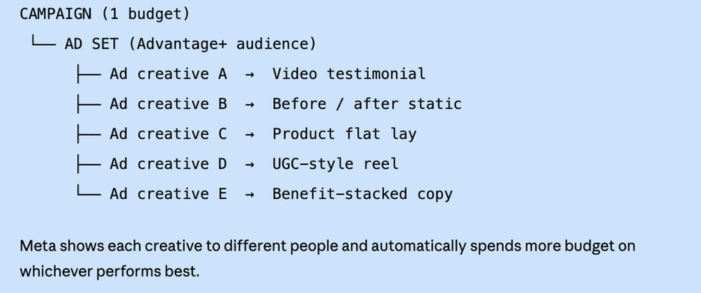
Together, that's why the structure has flipped: instead of telling Meta exactly who to show your ads to, you consolidate into fewer, larger campaigns, load in several creative variations, and let Meta's AI find the right people.
How multiple creatives work inside one campaign
What was missing entirely
Beyond the campaign structure, a few gaps were quietly capping her growth:
No lead generation campaign: She had an intro offer and an email platform already set up, but nothing running to actually grow her list through ads. Meaning your highest-converting channel — email — was underfed.
Creative that wasn't being refreshed enough. She had plenty of content sitting there. It just wasn't being rotated or varied the way the algorithm now expects.
No second set of eyes. She hadn't had any expert guidance in two years — this can be a long time when working on your own. Sometimes that second set of eyes is exactly what your business needs to keep moving forward.
None of this is a story about someone doing it wrong.
It's a story about someone doing it solo, for a long time, on a platform that doesn't send you a memo when it changes the rules.
What we actually did
She didn't want to hand her ads over completely — she wanted to keep running them herself, just with the account actually built right and someone in her corner. That's exactly what a Meta Ads Setup is for.
What we did inside her account:
Rebuilt her sales campaign using the new structure — stripping out the over-segmented targeting that was splitting her data and her budget.
Built a lead generation campaign connected directly to Klaviyo, using her existing intro offer, so every new email address collected through ads flows straight into her email automations.
Mapped out an Instagram profile growth campaign as a low-budget, always-on companion to her sales campaigns — the same approach that's helped other clients grow an account from 1,000 to 8,000 followers in under a year.
Ran a full 2-hour training session, recorded, so she could see exactly how the new structure worked and manage it with confidence going forward
14 days before Meta Ads Set up
Average ROAS: 1.63 | Average Cost Per Purchase: $96.11
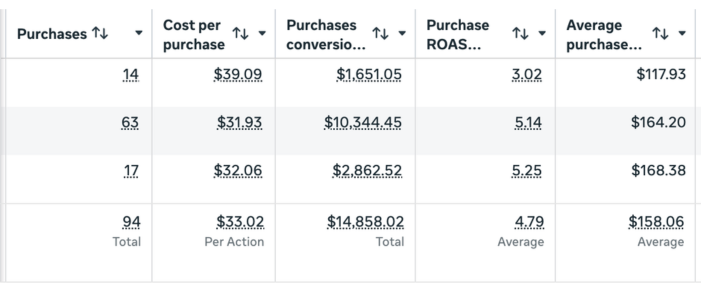
14 days after Meta Ads Set up
Average ROAS: 4.79 | Average Cost Per Purchase: $33.02
The bit worth remembering
If your ads used to work and now they don't, the instinct is usually to blame the creative, or the budget, or yourself when it’s simply the campaign setup you built two or three years ago that has quietly stopped matching how the platform actually works today.
You don’t need to do anything drastic; you just need the foundation rebuilt properly, by someone who can show you exactly what changed and why — so you can keep running it yourself with actual clarity, instead of guessing.
That's the whole point of a Meta Ads Setup.
Not to take over your account; it’s to hand you back a clean, modern account and the confidence to know what you're looking at.