

When NOT to Run Facebook Ads
E-commerce businesses that aren't ready for Meta ads are usually missing three things: a high-converting website that is above 3%. No email marketing set up and no organic content building trust and authority.
The biggest factor in whether Meta ads perform is your website. Ads do their job of getting someone to your website, but if the site is confusing to navigate, the customer journey breaks down and traffic won't convert, no matter how good the ads are. Aim for a 3% conversion rate as your bar; most Australian ecommerce sites convert around 2 - 4%.
How to Know If It's Time to Start Running Meta Ads
One of the most common questions I get asked is “Should I start running Facebook and Instagram ads?”
And my first three questions are:
Is your website conversion rate 3% or above
Do you have email marketing set up
Are you regularly posting organic content
If your website isn't converting at 3%+, you don't have email marketing set up, and you're not posting organic content, hold off on Meta ads — these are the basics that you need to ensure you’re getting the best results from your Ad budget.
Here is a quick checklist for you:
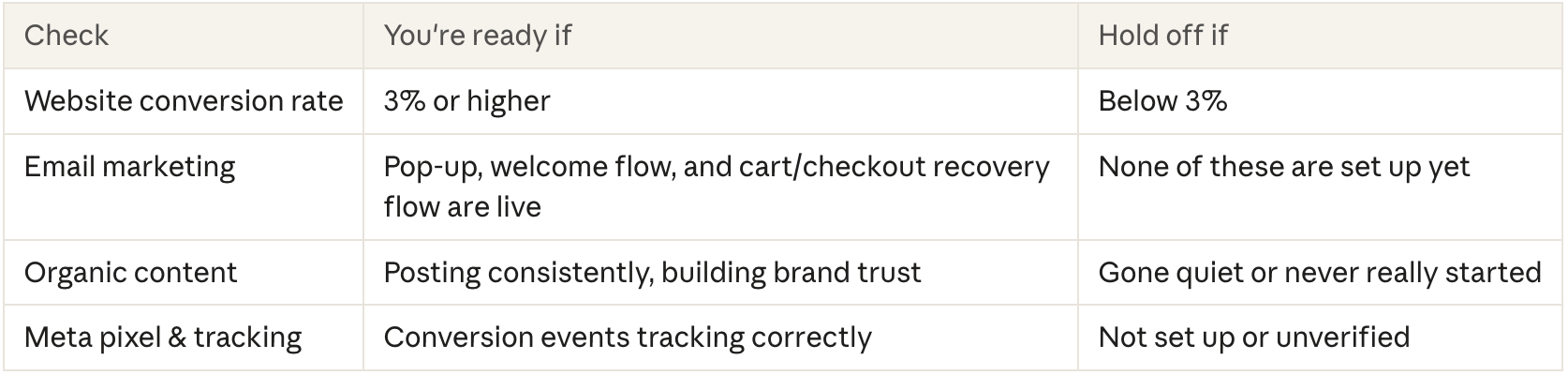
1. Your Website Conversion Rate Isn't High Enough Yet
Quick answer: Don't start Meta ads if your website conversion rate is below 3%. Meta ads amplify what's already working; they can't fix a low-converting website.
This is the big one.
Before we even talk about ads, I want to know your website's conversion rate. If it's sitting below 3%, we've got a website problem, not an ads problem.
Everything before the click is Meta's job: if your CTR and link clicks are low, people aren't stopping on your ad. That indicates a messaging or creative problem, not a website one.
Everything after the click is your website's job: if you've got solid traffic landing on your site but low add-to-carts or purchases, Meta's done its job and the drop-off is happening on your site, not in your ads.
Meta will only amplify what is already working.
If your website isn't converting the visitors you already have, paying to send more visitors doesn't solve anything.
Reasons why people are not converting could be a poor customer journey, slow loading times, confusing messaging or even hidden costs like shipping.
2. You Don't Have Email Marketing Set Up Yet
Quick answer: Before running Meta ads, set up an email pop-up, welcome flow, and cart/checkout recovery flow. Not everyone will buy on the first visit — email is where they'll convert later.
Here's something a lot of people miss: Not everyone who clicks your ad is going to buy on the spot. They might not be ready to purchase straight away, but they could be ready in a week, or a month, once they've gotten to know your brand a bit more.
So before you run a single ad, you need to make sure you're maximising the ways people can convert with you.
The three initial flows I would set up would be:
Welcome flow
Add a pop-up to your website so people can join your email list, and give them a reason to. People won't hand over their email address for nothing, so offer something in return, like a first-order discount, free shipping, or early access to new launches.From there, send a sequence of 2–3 emails that introduce your brand: who you are, why you started, and what makes your products different.
Abandon cart and checkout flows
You've paid Meta to bring someone to your website. They've browsed, added something to their cart, maybe even started checkout, and then they left. That's warm traffic you've already paid for walking out the door.These flows run in the background and remind people to come back and finish their purchase. Retargeting isn't always an ad. Sometimes it's an email, and for people who've already got that far, email often does the job better and costs you nothing extra.
Review request flow
Once someone has received their order, send an email asking for a review. Reviews are the lifeline of your business. They build trust and credibility with new customers, and they're some of the strongest social proof you can use on your product pages and in your ads.
3. You're Not Posting Organic Content Yet
Quick answer: When someone sees your ad, the first thing they'll usually do is check out your Instagram. If there's nothing there, or your last post was six months ago, you lose them. Organic content is what turns a random ad pitch into a brand they already feel like they know.
Think about what you do when an ad catches your eye. You don't buy straight away, you click through to the profile, scroll back through the posts, check who's behind it, and see if other people are talking about it. Your customers do the same thing.
If that profile is empty or inconsistent, you've paid Meta to send someone to your brand and given them nothing to trust once they get there.
Organic content is also your best testing ground. The posts that get saved, shared, and commented on show you which messages and angles actually land with your audience. Those make some of your strongest ad creative, and you've tested them before spending a dollar.
So if you've gone quiet on socials, or never really posted consistently, fix that before you start putting money behind ads.
Not Sure If You're Ready for Meta Ads? Let's Find Out Together
If you've read through this and you're not sure whether your business ticks these boxes yet, that's exactly what a discovery call is for. I'll give you my honest opinion on whether you're ready or not for Meta Ads.